“It’s Only a Bunch of Cells”
And God said ‘Let there be Light’.
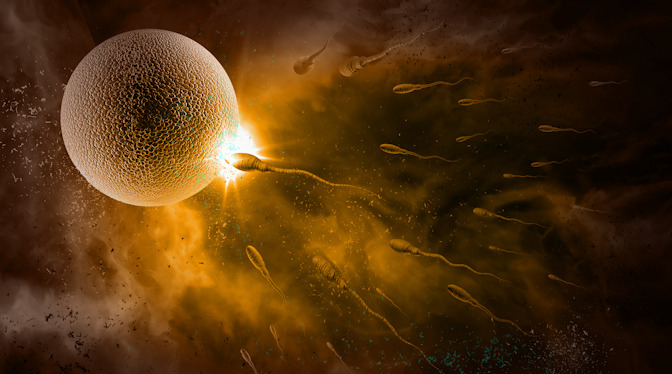
Science informs us that at the moment of conception, the atoms of the initial human cell are quantum mechanically entangled. A new being is formed. Human personhood has commenced. Since no organism can “become” a person unless it already is a person there can be no other moment at which a human attains personhood. Neither science nor ethics will ever be able to find such a (non-existent) point.
Before Abortion
After Abortion
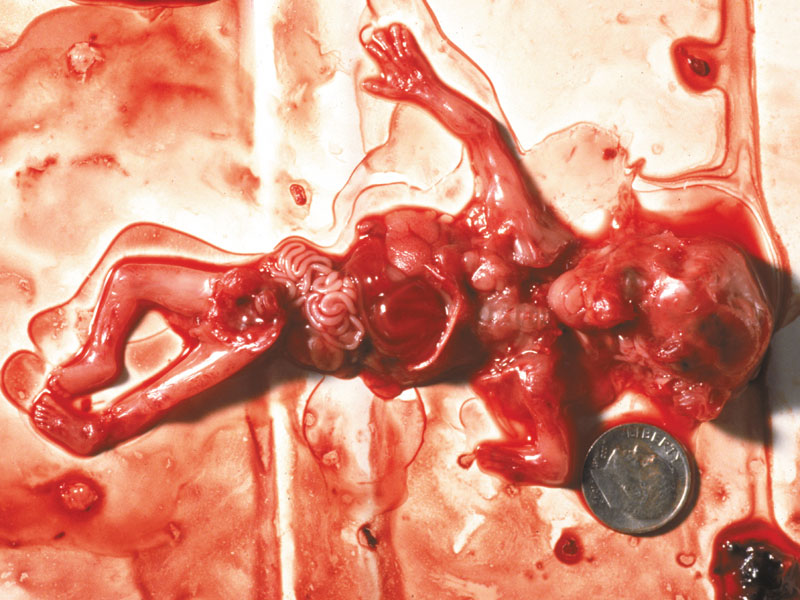
Up to the time of the flawed judicial decision which legalized abortion, Roe versus Wade, almost all embryology texts accepted the fact that the initial human cell fulfils the basic conditions for human life. It is the product of the union of two humans. It needs no further genetic information. The genotype is established for the entire life. Human characteristics including gender, bone structure, hair colour, skin colour, etc., are already determined. Only growth and development remain. See [1] for the viewpoint of a world renowned geneticist.
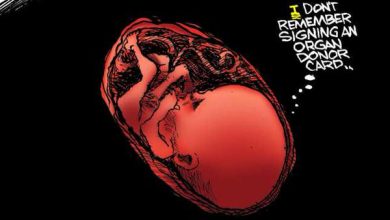
Nevertheless, the fact that a person is a person, no matter how small, is now questioned by those who favour killing the unborn. Advocates for abortion claim that the unborn human is merely a “bunch of cells”. While it is true that cells are part of the molecular structure of every human person, personhood is not determined ONLY by the number or type of atoms, molecules, cells, etc. A person is a person, even if the number of her cells is “small” or her size is “tiny”. As mentioned above, even the single first cell meets the characteristics required of personhood.
Before Abortion
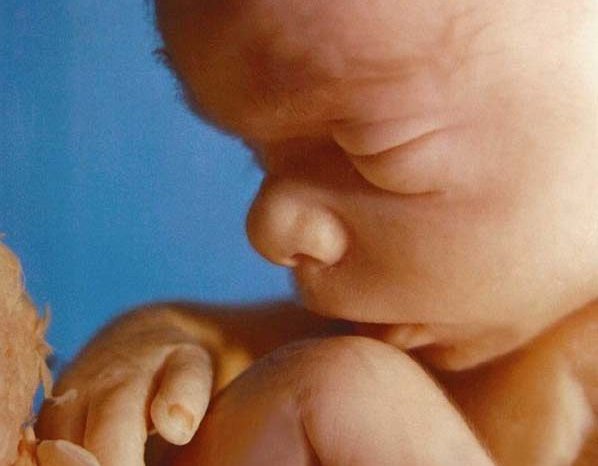
After Abortion
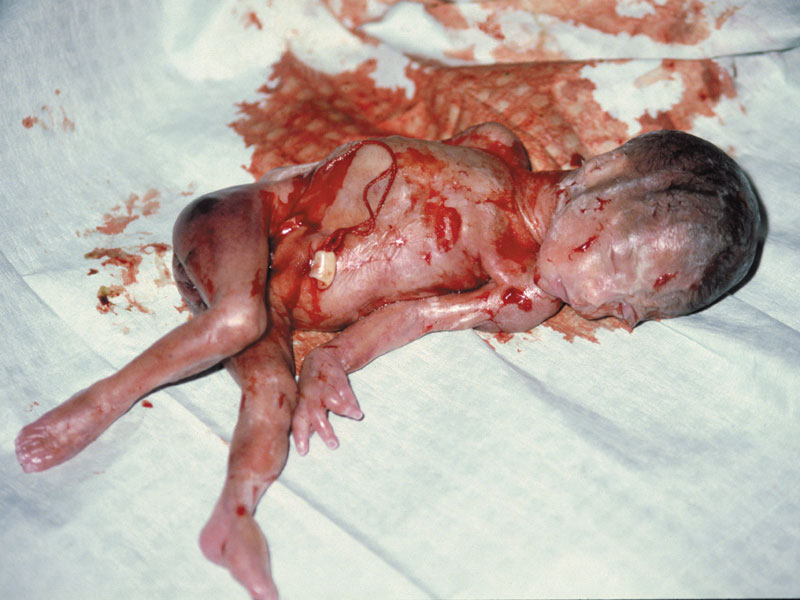
Proponents of abortion argue that the first cell is not much more than a code or blueprint based on DNA and therefore lacking moral worth. Whereas algorithms are finite, the state of even the smallest atom is described mathematically in terms of an infinite dimensional space. A person, therefore, cannot be identified with a code. In fact, there is much more to this cell than DNA. By weight, the DNA content of the initial human cell is only about one part in a trillion. The initial human cell or zygote, is actually a giant compared to all other human cells. Its precursor egg resides for years inside the ovaries, finally maturing during the process of ovulation. After fertilization, the number of atoms in the initial cell is approximately 4 x 10¹⁷, more than the stars in the Milky Way. It is not “merely a blueprint” for its future –a code without structure– but rather a human in the first stage of development. As the cell divides, the electromagnetic field properties of the helical DNA permit communication between different cells and rewriting of the genetic code. At all times, the initial human is a wholistic organism, capable of growth and interaction with its environment. It is not merely the sum of its parts. This reductionist view of nature has long been discredited by quantum mechanics [2]. Even the aborted child deserves more than the description “bunch of cells”.
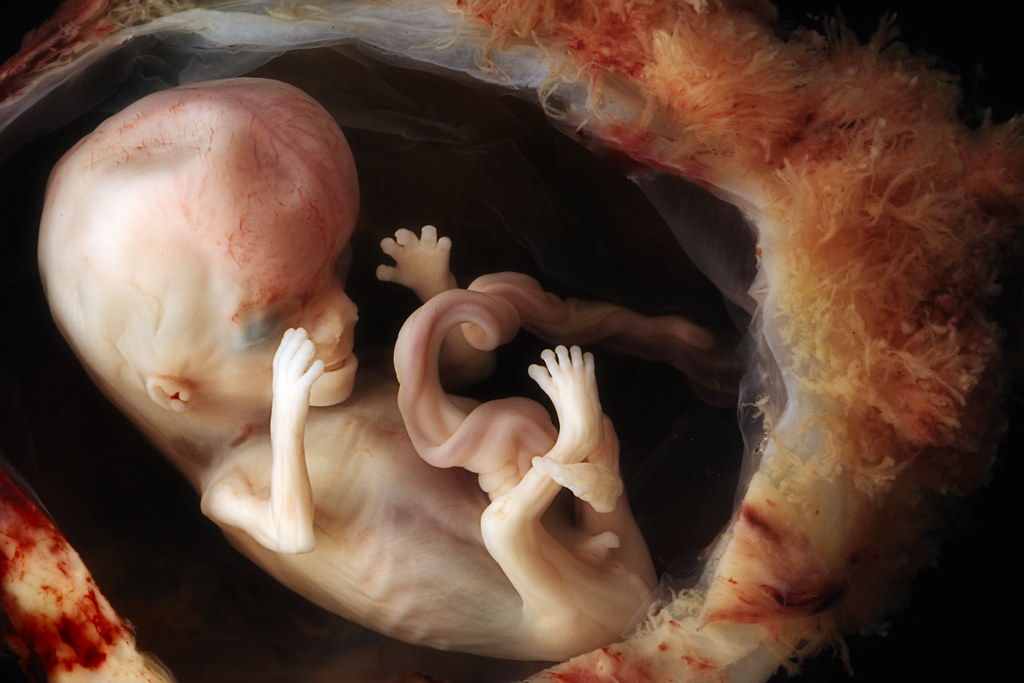
Some abortion advocates claim that personhood is only attained after certain physical or neurological structures have developed. Such ad hoc criteria, apart from lacking clear definition, completely ignore the fact that the first cell already satisfies the biological specification of human person. During development, there is no “moment” at which, for example, a heart suddenly begins to exist. Since a heart cannot arise out of nothing, some part of the DNA string must initiate its production. But, as stated previously, DNA is more than a mere algorithm. Its electromagnetic interaction with other cells and ability to replicate is such that waves of a baby’s heartbeat can currently be detected as early as three weeks after fertilization. It is, therefore, nonsense to pick out a moment within these first three weeks at which a heart “begins to exist.”
Nor can the concept of personhood be determined by such ill-defined notions as “starts to have a mind”, or “achieves consciousness”. The mind is not a body part. There is no way to encode notions such as consciousness into the laws of physics. A reductionist theory based, say, on gene structure can hardly explain something like “free will”. The universe is not deterministic and humans are not computers. Those who espouse this viewpoint are mixing metaphysical considerations with science. They must explain why a being who has achieved consciousness, and temporarily lost it while asleep or in a coma, is more valuable than a being who is about to achieve consciousness.
Neither does the medial terminology for each developmental stage –zygote, embryo, foetus, baby, child, teenager, adult, elderly–define personhood. Philosophically [3], the properties described by these terms are merely accidental. Indeed, the semantic difference between baby and foetus is often little more than a crude rhetorical device to justify the killing of the child. No pregnant woman refers to her “foetus.” Instead, she refers to her baby.
Before Abortion
After Abortion
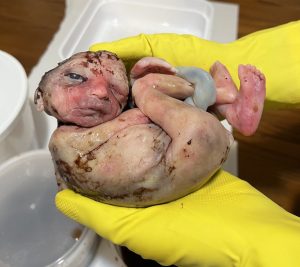
In conclusion, at no stage before the dissolution of the body is a person merely a “bunch of cells.” Even in death, human bodies merit more respect.
References
- The court testimony of Jérôme Lejeune in the article It’s About the Human Nature: What’s In the Fridge?
- Hans Primas. Chemistry, Quantum Mechanics and Reductionism, Perspectives in Theoretical Chemistry. Springer.
- Peter Kreeft. The Apple Argument against Abortion.
by Fieles a la Verdad