Reminding NeverTrumpists and Undecides
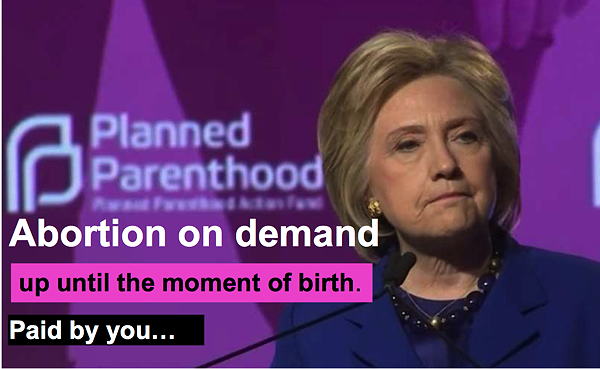
A NeverTrumpist friend, fearing that you are leaning Donald, lashes out: “But aren’t you bothered by his crude remarks about women (and so on)?” The vehement plea is intensified: “But aren’t you upset, irritated, exasperated?” “Of course, they are reprehensible,” you emphatically say, “But don’t you realize that NeverTrumping means voting for Hillary? Aren’t you morally revolted that, as Senator, she voted against banning late-term, partial-birth abortion and that, as President, she would extend abortion ‘rights’? Aren’t you morally concerned that your tax dollars fund Planned Parenthood and promote abortion?”
You could have simply answered: “But aren’t you bothered by Hillary’s ‘irredeemable’ innuendo, her ‘basket of deplorables,’ her ‘terrorists’ (pro-lifers), by her team’s contemptuous comments about Latinos, Southerners, Evangelicals, Catholics,…? Aren’t you irritated by double standards and hypocrisy?” Yet, your irony-challenged friend may not have appreciated the inconsistencies.
Your friend’s emotivistic worldview revolves around feelings, which the corrupt politician and the complicit media easily exploit. This subjectivistic lens of self-made, self-validating “conscience” blurs the distinction between words and action, braggadocio and substance, propaganda and historical fact, bluff and truth, fiction and reality. Overlooking objective ethical criteria, crucial facts and circumstances, it is unable to discern bad from worse, impropriety from injustice, prudential considerations (such as immigration policies) from intrinsic evil (such as the killing of innocent human life). Since feelings displace reasoned judgment, the disgust provoked by uncouthness is confused with the moral condemnation warranted by evil conduct.
In this emotivistic bubble, simple inconsistencies go undetected, conveniently dismissed, or sophistically justified. In it, similar behavior is labeled “crime” or “indiscretion,” depending on whether the agent’s name is Donald or Bill. In it, “if I had a baseball bat, I might have used it” is conceived as “incitement to violence and intimidation” or as “just a joke,” depending on whether the speaker is Donald or Sonia Sotomayor. Why? Because, in it, the emotion-fueled stereotypical opinion is the moral law.
You urge your friend to consider a Clintonian Supreme Court. The next president will probably be able to nominate four or more justices. Even the immediate choice, to fill Scalia’s bench, will irrevocably tilt the Court.
In the second presidential debate, Hillary Clinton was asked what she would “prioritize as the most important aspect of selecting a Supreme Court justice.” She replied: “appoint Supreme Court justices who understand the way the world really works, who have real-life experience, who have not just been in a big law firm and maybe clerked for a judge and then gotten on the bench, but […] actually understand what people are up against.” She added: “I want a Supreme Court that will stick with Roe v. Wade and a woman’s right to choose, and with marriage equality,” “that understands because you’re wealthy and you can give more money to something doesn’t mean you have any more rights or should have any more rights than anybody else.” In the third debate, she elaborated: “we need a Supreme court that will stand up on behalf of women rights, on behalf of the rights of the LGBT community, that will stand up and say no to Citizens United…”
In the second debate, Donald Trump’s answer to the Supreme Court question was: “I am looking to appoint judges very much in the mold of Justice Scalia. I’m looking for judges — and I’ve actually picked 20 of them so that people would see, highly respected, highly thought of, and actually very beautifully reviewed by just about everybody,” “people that will respect the Constitution of the United States.” In the third debate, he expounded: “pro-life,” “great scholars in all cases and people of tremendous respect” who “will interpret the Constitution the way the Founders wanted.”
Trump’s carefully crafted list of potential Supreme Court justices has been, indeed, vetted and widely praised. Where is Hillary Clinton’s list of justices? Her debate answers unabashedly underscore that, for her, constitutional acumen, legal scholarship, professional integrity, and judicial restraint and reputation are secondary. Her ideal justice fits the mold of pro-choice and LGBT rights advocate Elena Kagan who, in her confirmation hearings, stated “I don’t have a view of what are natural rights, independent of the Constitution.” (Are, then, the people of other countries bereft of natural rights?) Or, perhaps, in the mold of Sonia Sotomayor who said: “I would hope that a wise Latina woman with the richness of her experiences would more often than not reach a better conclusion than a white male who hasn’t lived that life.” By the way, as Senator, as Secretary of State, and as part of the Clinton Foundation, did Hillary follow and enforce her maxim that “because you’re wealthy and you can give more money to something doesn’t mean you have any more rights or should have any more rights than anybody else”? Just asking.
The Supreme Court, as interpreter of federal constitutional law, was once regarded as the last hope for justice and redress, as the remaining stronghold amidst the American republic’s fragile system of checks and balances. Its members solemnly swear to “administer justice without respect to persons” and to “faithfully and impartially discharge and perform all the duties incumbent upon them under the Constitution and laws of the United States; and to support and defend the Constitution of the United States against all enemies, foreign and domestic; to bear true faith and allegiance to the same…”
Though often described as a textualist, Antonin Scalia also understood that the Constitution cannot be divorced from the natural law. Unlike positive law, natural law can neither be created, modified, nor repealed, depending on place and time. Discoverable by reason, the natural law upholds the necessary conditions for personal preservation, fulfillment, and flourishing and, consequently, grounds the very notion and existence of universal and inalienable human rights. Otherwise, “human rights” would be ill-defined, shifting relative desires, preferences, or choices, hostage to ideology, political pressure, special interests, or the latest cause célèbre. Fundamental “human rights” would be thus progressively redefined, their essence eroded, while new “particular rights” are created in order to suit the demands of constituencies that bring funding and votes. For instance, novel and creative interpretations of “hate speech” and “fairness” doctrines may curtail the free exercise of expression and religion, effectively shutting up dissent. “Universal” rights, based on essential human nature, gradually give way to contingent, custom-made “special” rights based on class affiliation, whether real or perceived.
In his dissent from the Obergefell v. Hodges decision that legally redefined marriage rights, Scalia tellingly concluded that the Supreme Court had become a “threat to American democracy.” He explained: “Today’s decree says that my Ruler, and the Ruler of 320 million Americans coast-to-coast, is a majority of the nine lawyers on the Supreme Court. This practice of constitutional revision by an unelected committee of nine, always accompanied (as it is today) by extravagant praise of liberty, robs the People of the most important liberty they asserted in the Declaration of Independence and won in the Revolution of 1776: the freedom to govern themselves.”
Still NeverTrumping or undecided? Following Scalia’s logic, a Clintonian Court could spell the end of constitutional democracy. Instead of self-government, the “constitutional revision by an unelected committee of nine” would rule the land for decades to come — only by resounding 7-2 decisions instead of the recent 5-4. Both a POTUS and a SCOTUS promulgating laws, with Congress timidly tagging along. À la Obama… only worse and for much longer.
Have you thought about an America ruled by an imperial body dressed in liberal robes? Do you realize that the very freedom of conscience that you now smugly invoke is at stake? Does crudeness weigh more than the real threat to the dignity of the unborn and the terminally ill, freedom of speech, conscience and religious rights, state rights, and government restraint? In this election’s unenviable choice between two maladies, not choosing the flu inevitably brings about deadly, pandemic pneumonia.
Still emoting, your friend blasts: “But aren’t you offended by Donald’s demeanor?” You pivot again to facts: “Hillary’s private non-secure email server as Secretary of State, the Clinton Foundation’s quid pro quo deals, her inaction in Benghazi whose outcome was four Americans killed and the subsequent cover-up, her mishandling of classified information, the totalitarian agendas of some of her campaign’s main donors, her “religious beliefs have to be changed” along with the front groups created to upend the Catholic Church, the Whitewater, Filegate, and Travelgate scandals, her dystopia of open borders and a bigger, encroaching federal government,… On the other hand, Trump’s vice presidential pick, the expertise and credibility of his main advisors, his list of possible Supreme Court justices (which, should you ask, includes women, as well as people of African-American, Hispanic, and South Asian descent),…” You are impatiently interrupted: “But he cannot be trusted.” At this point, you need only reply: “Can she?”
Fieles a la Verdad
October 24, 2016
© Copyright 2016
Permission to reproduce is granted subject to inclusion of a link to this page.